Technical.Graffiti

What is GEO - Generative Engine Optimisation? How to Get Your Business Found by AI Search Engines

What is GEO?
Generative Engine Optimisation explained.

Most people have heard of SEO.GEO is what comes after it.

GEO stands for Generative Engine Optimisation. It is the discipline of making your business visible to AI-powered search engines — the kind that give a single, direct answer instead of a list of ten links.

The difference between
SEO and GEO.

With traditional SEO, you optimise your website so it ranks on page one of Google. The customer searches, sees your link among others, clicks through, and decides whether to contact you.

With GEO, there are no ten links. There is one answer.

When someone asks ChatGPT "who is the best plumber in Wellingborough" or asks Google's AI Overview "which solicitor near me specialises in employment law," they get a single recommended business — or a very short list of two or three.

Everyone outside that answer does not exist to that customer.

GEO is the work of making sure your business is inside that answer, not outside it.
Your competitors get the recommendation. You get nothing.

Why GEO matters
right now.

AI search is not a future trend. It is already the default for a growing proportion of searches.

Google's AI Overviews now appear on roughly 40% of all searches in the UK. ChatGPT, Perplexity, and Microsoft Copilot are being used daily by millions of people who are no longer scanning through links — they are asking questions and acting on the first answer they receive.

For local and trade businesses, this shift is particularly sharp.

When a homeowner in Northampton needs a boiler repaired, they are increasingly asking an AI assistant rather than typing "boiler repair Northampton" into Google.

If your business is not visible to that AI, that enquiry goes to someone else. Every time. Without exception.
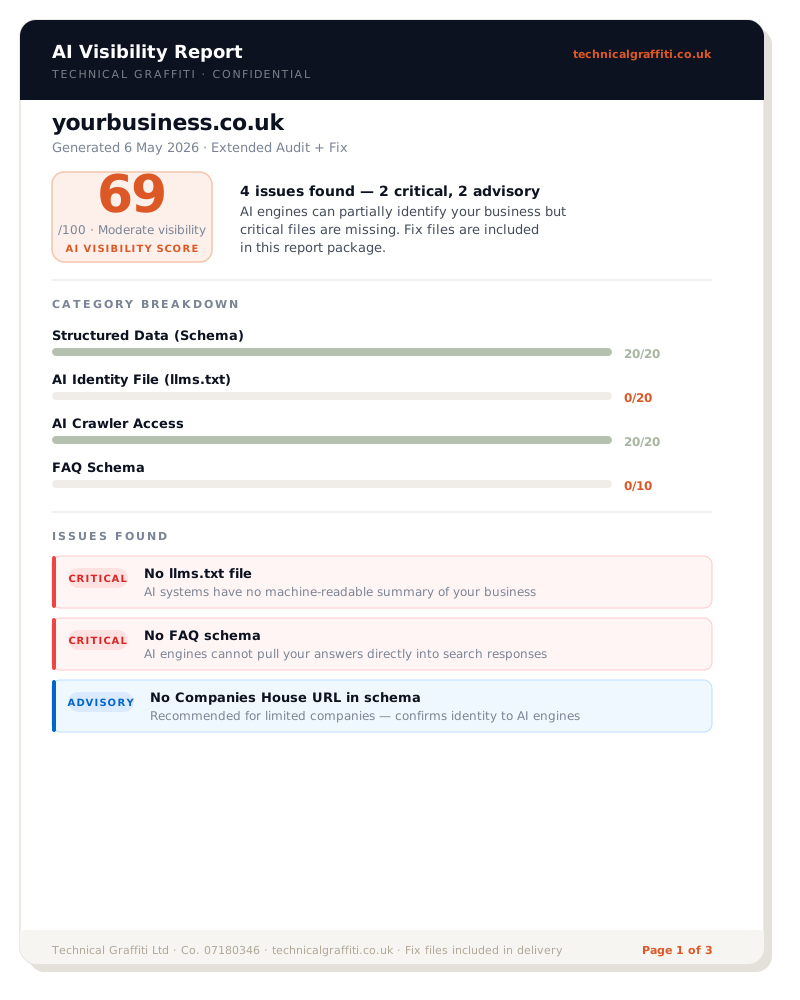
Does your site pass the AI visibility check?

The only proof that matters is your own.

Run the free check on your own domain. Whatever comes back is real — generated live, against your actual website, in front of you. Nobody can fake that on your behalf.

Free · 60 seconds · No account needed

What GEO

actually involves.

GEO is not the same as writing more content or building more backlinks. GEO is about making your website legible to machines that are making recommendations.
→ There are three core components:

01

Structured identity signals.(Schema markup)
AI engines look for schema markup — structured code that tells them who you are, what you do, where you operate, and how to reach you. Without it, AI treats your site as an anonymous page with no verified identity.
It will not recommend something it cannot verify.

02

An AI-readable identity file.(llms.txt)
A file called llms.txt placed at the root of your website is a machine-readable summary of your business written specifically for AI crawlers.
When GPTBot, ClaudeBot, or PerplexityBot visits your site, this is often the first thing they read.

03

Citation consistency
AI engines cross-reference your business across the web. Your business name, address, and phone number need to match exactly across your website, Google Business Profile and directory listings.
Infact, anywhere your business appears.

The stark reality

GEO versus traditional SEO

— what stays, what changes.

GEO does not replace SEO. It extends it.

The fundamentals still apply: a fast, well-structured website, relevant content, genuine backlinks, a complete Google Business Profile. These things matter for both search engines and AI engines because AI engines use search engine data as one of their inputs.

What GEO adds is a technical layer specifically for AI. The schema markup, the llms.txt file, the citation consistency — these are the signals that AI engines are looking for that traditional SEO never required. Most businesses have not added them because nobody told them they needed to.
That gap is an opportunity for any business willing to act on it now, before competitors in their area do the same.

Who needs

GEO?

Any business that relies on customers finding it locally needs GEO. That includes:
  • Tradespeople — plumbers, electricians, builders, roofers, landscapers
  • Health and wellness practitioners — physiotherapists, osteopaths, dentists, chiropractors
  • Legal and financial services — solicitors, accountants, mortgage brokers, financial advisers
  • Hospitality and retail — restaurants, hotels, independent shops
  • Professional services — architects, surveyors, consultants
  • Any business with a local catchment area where word of mouth and local recommendations matter
The shift affects businesses of all sizes, but the urgency is greatest for small and medium-sized businesses. Large brands have dedicated marketing teams and development resources to adapt quickly. A sole trader in Wellingborough or a two-person accountancy practice in Leicester does not.
The window to act while competitors have not yet acted is open now and it will close.
Get found by AI. In minutes.

Don't let your competitor be the answer.
Make sure it's you.

Your AI visibility files - generated and delivered automatically in minutes.

Over 90% of businesses are completely invisible to AI search. When a customer asks ChatGPT, Gemini, or Perplexity for a recommendation, the engines only cite the rare brands they can technically verify.

If that isn’t you, your rival gets the lead.

Secure your digital footprint before your competitors wake up to GEO.

Free · 60 seconds · No account needed